
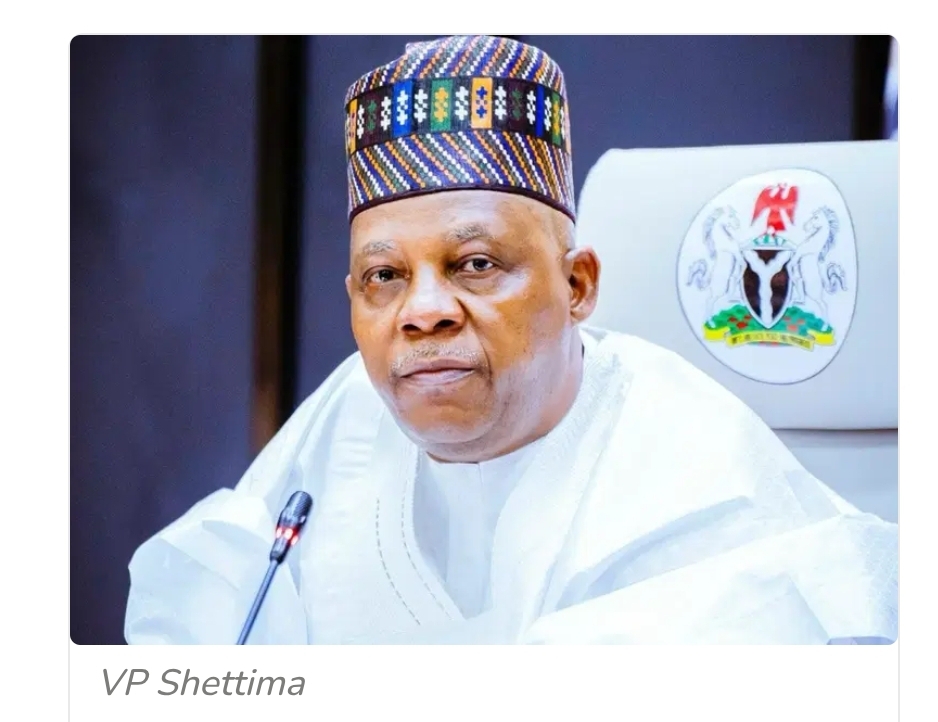
2027: Shettima Warns APC Internal Crisis Could Threaten Tinubu’s Re-election

2027: Shettima Warns APC Internal Crisis Could Threaten Tinubu’s Re-election
By Akin Alade
Vice President Kashim Shettima has raised fresh concerns over the growing internal contradictions within the All Progressives Congress (APC), warning that unresolved disagreements, political rivalries and divisions among party stakeholders could pose a greater threat to President Bola Ahmed Tinubu’s re-election bid in 2027 than the opposition.
Shettima’s warning has brought renewed attention to the challenges confronting the ruling party, particularly allegations of candidate imposition, dissatisfaction among political stakeholders and disputes arising from party primaries. His remarks suggest that the APC’s greatest electoral challenge may not necessarily come from former Vice President Atiku Abubakar or former Anambra State Governor Peter Obi, but from its ability to maintain unity within its ranks.
Speaking in Abuja during the unveiling of the campaign headquarters of Arewa for Asiwaju (A4A), a northern political coalition supporting the Tinubu-Shettima ticket, the Vice President expressed confidence in the ruling party’s electoral strength but cautioned that internal disagreements could undermine its political advantage. He stressed that unity, loyalty and collective responsibility would be essential to securing victory in the forthcoming general elections.
The Vice President particularly warned against a situation where party leaders mobilise support for Tinubu’s presidential ambition while working against APC governors and other candidates contesting elections on the same platform. According to him, such contradictory political interests could weaken the party’s grassroots structures and create unnecessary divisions capable of affecting its electoral fortunes.
Political developments within the APC have already generated concerns in several states, where disputes over party nominations, allegations of exclusion and disagreements among influential stakeholders have tested internal cohesion. Although the ruling party maintains significant political influence across the country, analysts believe its ability to reconcile aggrieved members and address outstanding grievances could determine how effectively it converts that strength into electoral victory.
Shettima nevertheless expressed optimism about the APC’s chances, citing its extensive political structures across Nigeria’s 176,845 polling units. He maintained that the party possesses sufficient organisational capacity to confront the opposition, provided its members work together. He also urged political appointees and party officials to demonstrate their relevance by delivering electoral victories at their polling units, wards and local government areas.
On the political situation in Northern Nigeria, the Vice President declared that the region had demonstrated substantial support for Tinubu’s second-term ambition. He argued that the administration’s economic reforms and infrastructure investments had strengthened its prospects, while acknowledging that many Nigerian households continued to experience economic difficulties. Shettima defended the President’s economic management, insisting that the administration inherited serious financial challenges and had taken difficult decisions to stabilise the country.
The APC National Chairman, Professor Nentawe Yilwatda, also expressed confidence in Tinubu’s re-election prospects, pointing to ongoing federal infrastructure projects as evidence of the administration’s commitment to national development. However, Shettima’s warning has introduced a significant dimension to the 2027 political calculations: the ruling party must not allow internal political ambitions, unresolved grievances and competing interests to undermine its campaign.
With preparations for the 2027 general elections gathering momentum, the Vice President’s intervention places the responsibility for reconciliation squarely on the APC leadership. The central question is whether the party can successfully manage its internal differences and present a united political front, or whether divisions within its own ranks will provide the opposition with an opportunity to challenge its dominance.